
Why Most Creative Briefs Fail (and What I Use Instead)
Creative briefs are supposed to make projects clearer. In practice, they often do the opposite.
They’re either:
Too vague to be useful
Too long to be read
Too rigid to reflect how real projects evolve
And by the time the work begins, everyone is already interpreting something different.
That’s where most projects start to drift.
The Problem Isn’t the Brief — It’s How It’s Used
Most creative briefs are treated as a formality. Something to fill out at the beginning of a project. Something to check off before design starts.
But in professional environments, the brief isn’t just documentation. It’s a decision-making tool.
It should:
Align teams before work begins
Clarify priorities when tradeoffs happen
Provide language for explaining and defending decisions
Carry through the entire project lifecycle
When it doesn’t do those things, the work has no shared foundation.
What I See as a Creative Director
After years of working across branding, UX/UI, and integrated campaigns, I’ve seen the same issues show up again and again:
Stakeholders answer questions differently—or not at all
Goals are implied instead of stated
Audience definitions are too broad to be actionable
Success isn’t clearly defined
The brief gets ignored as soon as design starts
None of this is intentional. It’s usually a result of tools that don’t match how teams actually think and communicate.
The result is predictable:
More revisions.
More misalignment.
More time spent explaining decisions that should have been clear from the start.
What a Brief Actually Needs to Do
A useful creative brief doesn’t just collect information.
It guides thinking.
It helps people:
Answer the right questions in the right order
Move from vague ideas to specific direction
Understand what matters—and what doesn’t
Make decisions with shared context
That requires more than a static document. It requires structure.
Why Most Templates Fall Short
Most templates are either:
Too generic to guide meaningful input
Too complex to complete efficiently
Or designed for a single type of project
They assume the person filling them out already knows how to think like a strategist, a designer, and a stakeholder—all at once.
That’s rarely the case. So the brief gets filled out quickly, inconsistently, or not at all. And the team fills in the gaps later.
What I Use Instead
Over time, I stopped relying on traditional briefs and started building something more practical.
A structure that:
Walks stakeholders through decisions step by step
Adapts to different types of creative work
Keeps teams aligned as projects evolve
Reflects how real creative work actually happens
That became my Interactive Creative Brief Template.
Not as a product at first—but as a working tool I used across projects to reduce friction, improve clarity, and keep teams aligned.
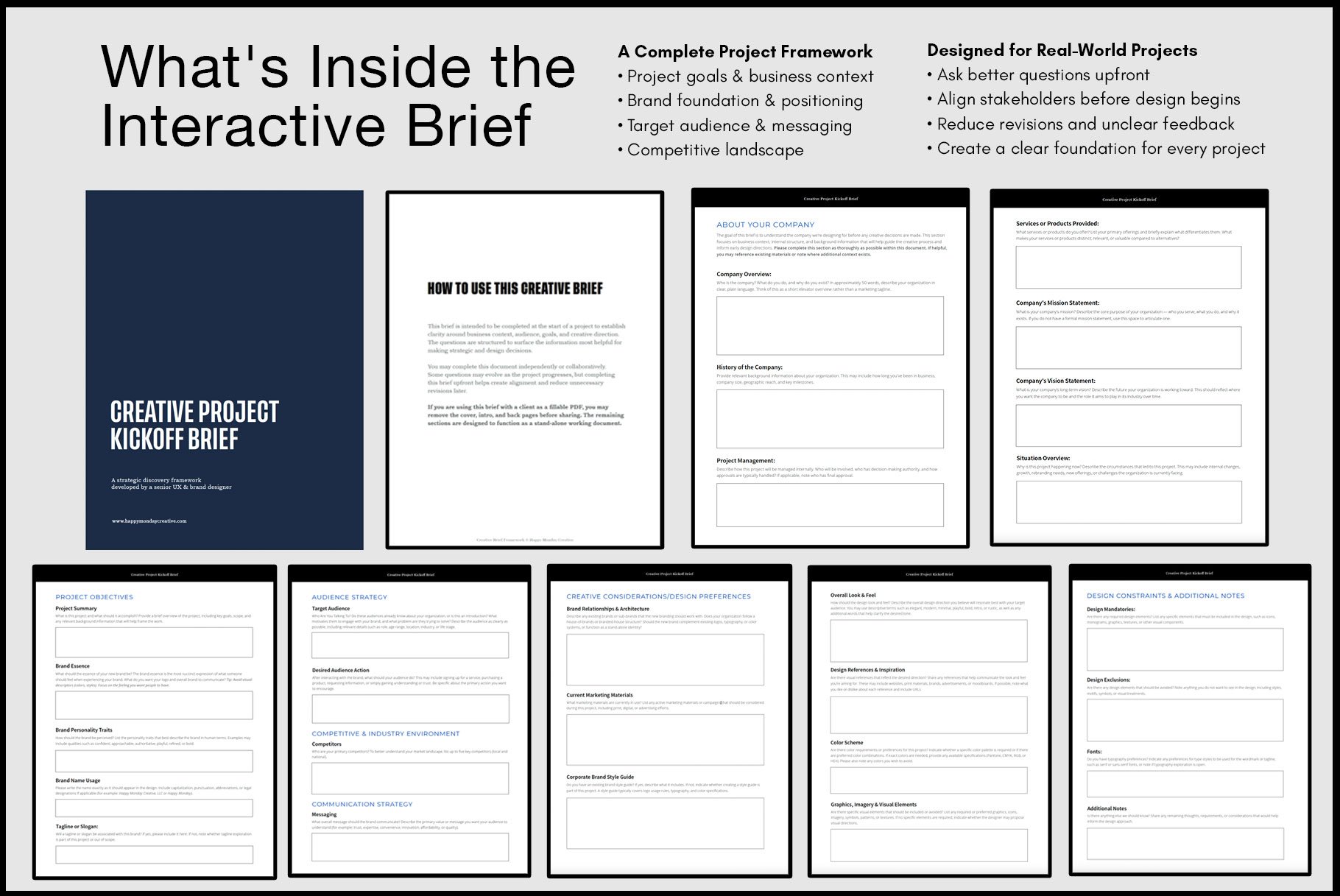
How It’s Different
The goal wasn’t to make a “better form.”
It was to make a brief that actually functions inside real workflows.
That means:
Guided inputs instead of open-ended questions
So stakeholders know how to answer—not just what to answerStructured sections that build on each other
So the brief develops logically instead of feeling scatteredFlexibility across branding, UX/UI, and illustration work
So it works in different contexts without needing to be rebuiltA format that can be revisited throughout the project
Not something that gets ignored after kickoff
It’s designed to support clarity at the beginning—and consistency all the way through.
Why This Matters
When the brief is clear:
Teams align faster
Decisions are easier to defend
Revisions are more focused
The work moves forward with less friction
When it isn’t, everything becomes reactive.
More interpretation.
More correction.
More backtracking.
The brief doesn’t eliminate complexity—but it gives everyone a shared way to navigate it.
If You’re Running Into This Too
If you’ve ever felt like:
You’re re-explaining decisions that should already be clear
Projects shift direction mid-stream
Stakeholders aren’t aligned, even when they think they are
It’s often not a design problem. It’s a brief problem.
The Tool I Use
I’ve turned the system I use into a working template you can use in your own projects:
👉 Interactive Creative Brief Template
👉 Also available on Creative Market listing
It’s designed for real-world creative work—not as a theoretical exercise, but as something you can use immediately to improve clarity and reduce friction.
The Takeaway
A creative brief isn’t just a starting point. It’s the foundation for how decisions are made, explained, and carried forward.
When that foundation is unclear, everything built on top of it becomes harder. When it’s structured well, the work has a much better chance of moving forward with clarity from the start.
About This Series
Notes from a Creative Director Designing Patterns
This series documents my ongoing pattern and illustration practice through the lens of a Creative Director and UX/UI designer with 25+ years of professional experience.
Rather than teaching a prescribed method or selling a course, the focus is on process, systems thinking, and real-world application—how illustration and pattern design function within branding, licensing, and professional creative environments.
This is not a beginner tutorial series or a hustle playbook. It’s a working record of building pattern systems with intention, clarity, and long-term use in mind.
If you’re interested in thoughtful design, scalable illustration, and process-driven creative work, you’re in the right place.