Bringing Little Bavaria to Life Through an Illustrated Map of Frankenmuth
Copyright © 2026, Happy Monday, LLC. All rights reserved. No reproduction or use without permission.
Overview
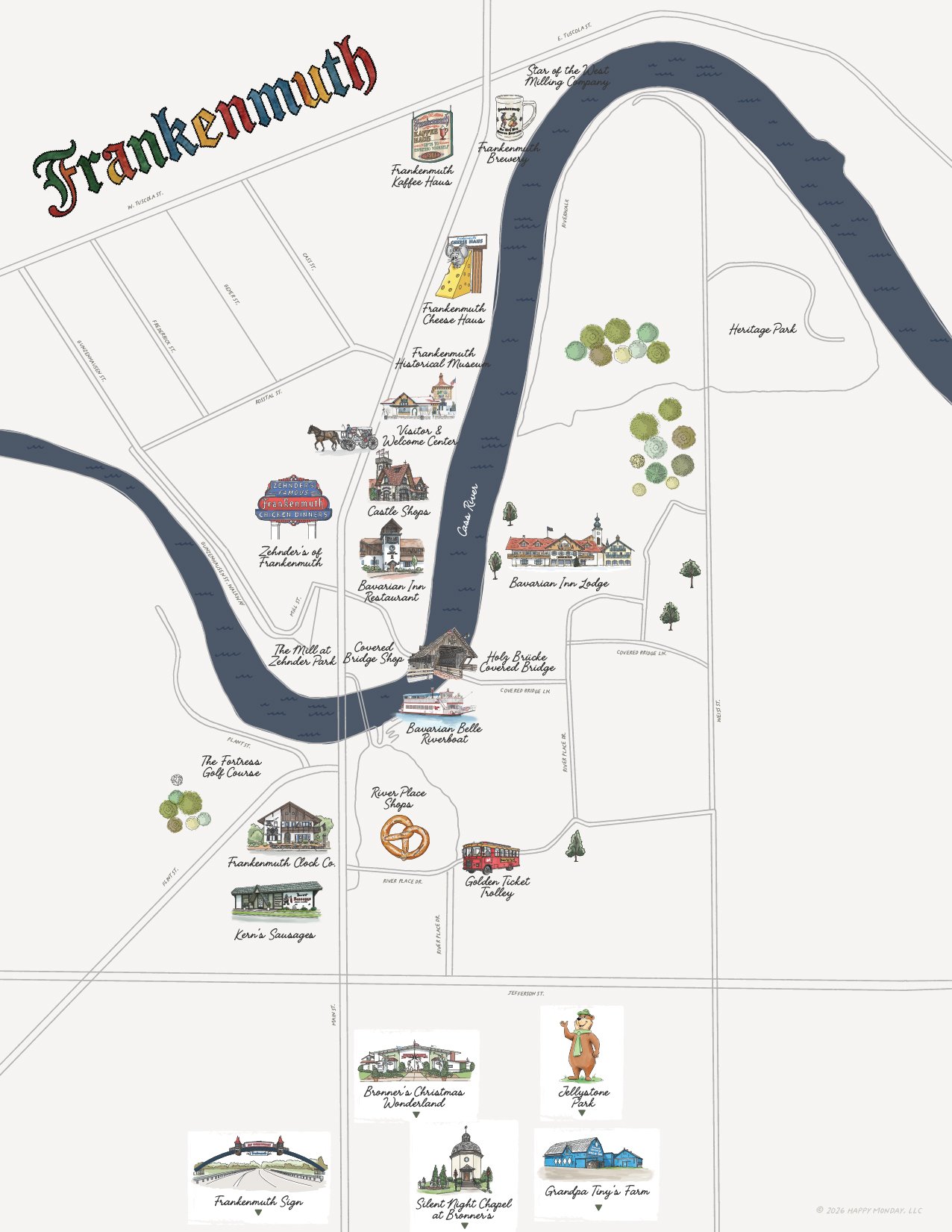
This project explores the early stages of an illustrated map for Frankenmuth, Michigan—developed as an extension of a broader surface pattern and illustration system.
Rather than beginning with finished artwork, this phase focuses on structure, layout, and spatial clarity—establishing the foundation that the final illustration will be built on.
The goal is to create a map that feels expressive and story-driven, while still being grounded in real geography and usable as part of a larger visual system.
The Opportunity
Frankenmuth—often referred to as “Little Bavaria”—is a destination built on experience, tradition, and recognizable landmarks.
The challenge wasn’t just to illustrate the town, but to:
Capture its identity in a way that feels cohesive across formats
Translate a growing library of illustrated elements into a spatial layout
Balance charm and storytelling with readability and structure
This map is part of a larger exploration into how illustrated systems can support:
Destination branding
Visitor experiences
Retail and product applications
Process: Starting with Structure
Before any stylistic refinement begins, the focus is on building a clear and accurate foundation. At this stage, the work is intentionally restrained—closer to a wireframe than a finished illustration.
Key priorities:
Mapping the street layout and river accurately
Establishing scale across the full composition
Placing landmarks in correct relative positions
Testing spacing, density, and visual flow
This ensures that the final map will feel intuitive and balanced—not just decorative.
Why Share the Process
I’m intentionally sharing this map in its early stages because this is where the most important decisions happen—before style, color, and detail are layered in. This phase is focused on structure: mapping streets, placing landmarks, and working through scale, density, and flow.
I’m also sharing this for other designers. This is a process I’ve developed largely on my own over the years, and this stage—the part that’s usually hidden—is where the real work happens.
The way elements are organized here determines how the map will read, how it connects back to the pattern collection, and how the artwork can extend across formats. By making this phase visible, I’m showing how the work is built—not just how it looks when it’s finished.
What’s Being Explored
This phase is less about final visuals and more about decision-making:
Landmark selection
What defines the experience of Frankenmuth—and what can be left out?Illustration vs. abstraction
Which elements deserve full illustration, and which should remain simplified?Density and hierarchy
How much detail is too much? Where should the eye go first?System alignment
How this map connects back to the existing pattern collection and illustration assets
Why This Approach Matters
Although the final piece will feel loose, hand-drawn, and expressive, the structure underneath is intentional.
This phase allows the work to move beyond a single illustration into a scalable system:
The same assets can live in both pattern and map formats
Elements can be reused across print, product, and digital applications
The visual language remains consistent across touchpoints
Next Phase
Once the layout is finalized, the next stage will introduce:
Fully rendered illustrated landmarks
Color and tonal balance
Typography and labeling
Additional moments of personality and storytelling
Want to bring your own destination to life? I’d love to help!
COPYRIGHT NOTICE:
This artwork is protected by copyright. The individual illustrations are not available for separate purchase or as stock imagery. All rights are reserved, and licensing inquiries are welcome for custom commissions only.
I take protecting my work seriously, as I’ve discovered multiple individuals and companies using my illustrations without permission. All images are digitally watermarked and monitored. Unauthorized use, reproduction, redistribution, or adaptation — including reposting online — is strictly prohibited. If detected, a formal cease and desist will be issued, and legal action may follow.